
The Last Thing America Agreed On
In the era of a thousand choices, one consensus reigned true

Think about the last time you met someone named Michael.
Probably didn’t take long. There are an estimated 4.1 million of them alive in America right now, more people than the city of Los Angeles.
Michael was the most popular boys’ name in America for 44 of the last 100 years. In its peak years, more than 5% of all male births carried it. One name. One in twenty boys. You couldn’t walk into a classroom, a bar, an office without finding one.
Jennifer did the same for girls. Then Jessica. Then Emily, 13 years at the top. In each era, one name absorbed a disproportionate share of the country’s collective imagination and held it. Parents were participating in something gravitational.
But that world is gone.
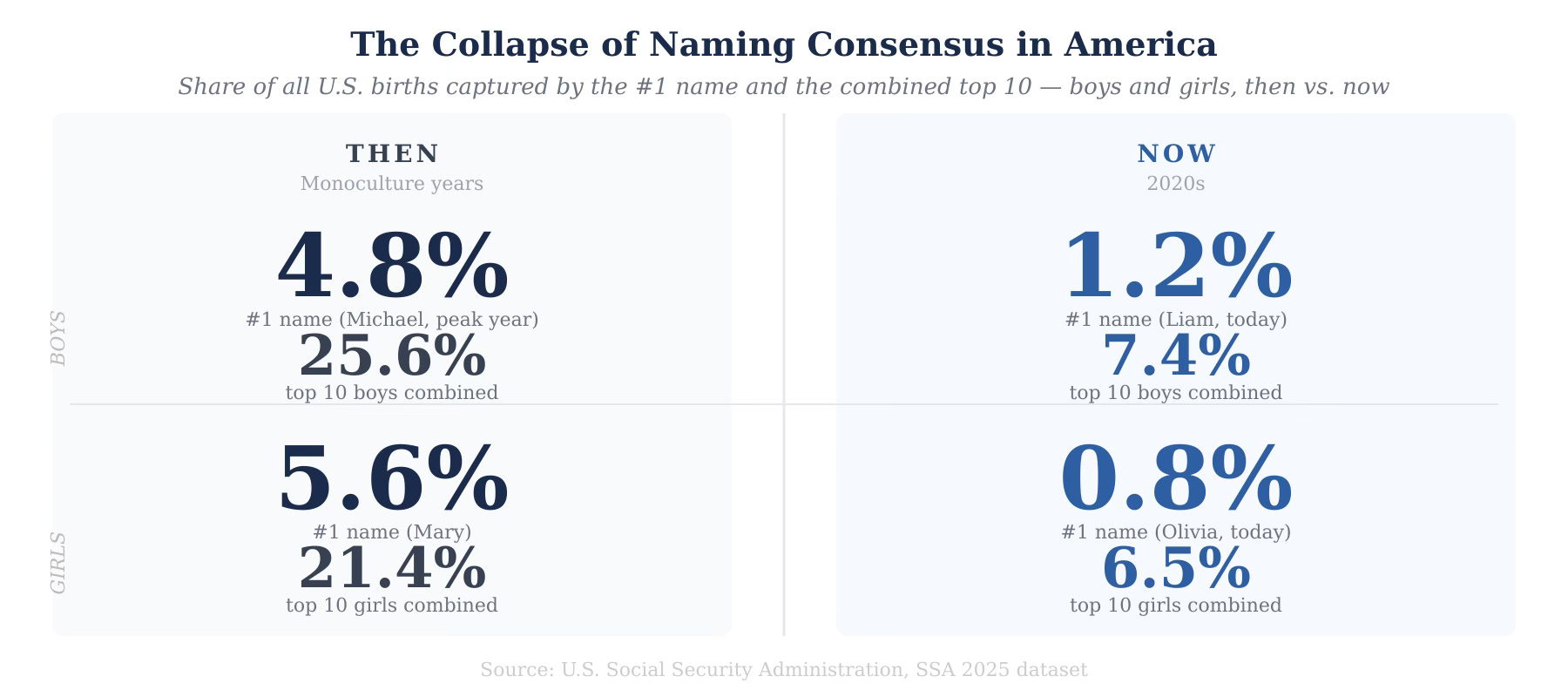
In 1925, Mary accounted for 5.6% of all girls born in America. Jennifer peaked at 3.4% in the 1970s. Today, Olivia, the most popular girl’s name, accounts for just 0.8%.
For boys, Michael once commanded 4.8% of all births. Today Liam, sitting at #1, takes about 1.2%.
The top 10 boys’ names combined once covered 25.6% of all male births. The top 10 girls’ names covered 21.4%. Today those figures are 7.4% and 6.5%. Nearly 30% of babies born in America now receive names that don’t crack the top 1,000.
The playground test is broken. Shouting a name across a schoolyard and watching heads turn doesn’t work anymore. An era of individualism, a desire to stand out, and the long chase of internet culture has fueled such a fragmented change.
We have never, in recorded American history, been less uniform in what we name our children.
Names used to move through American culture the same way everything else did: slowly and together. A handful of television shows, a shared radio dial, a few national magazines. Trends traveled in wide, predictable waves. When a name caught on, it caught on everywhere.
But the internet shattered that dynamic.
Today culture splinters into thousands of overlapping communities, each with their own celebrities, aesthetics, and influences. Naming followed the same path. Instead of a few dominant names, we now have thousands of smaller ones.
The statistical center collapsed.
Which is why what happened next is one of the most interesting stories in modern American naming data.
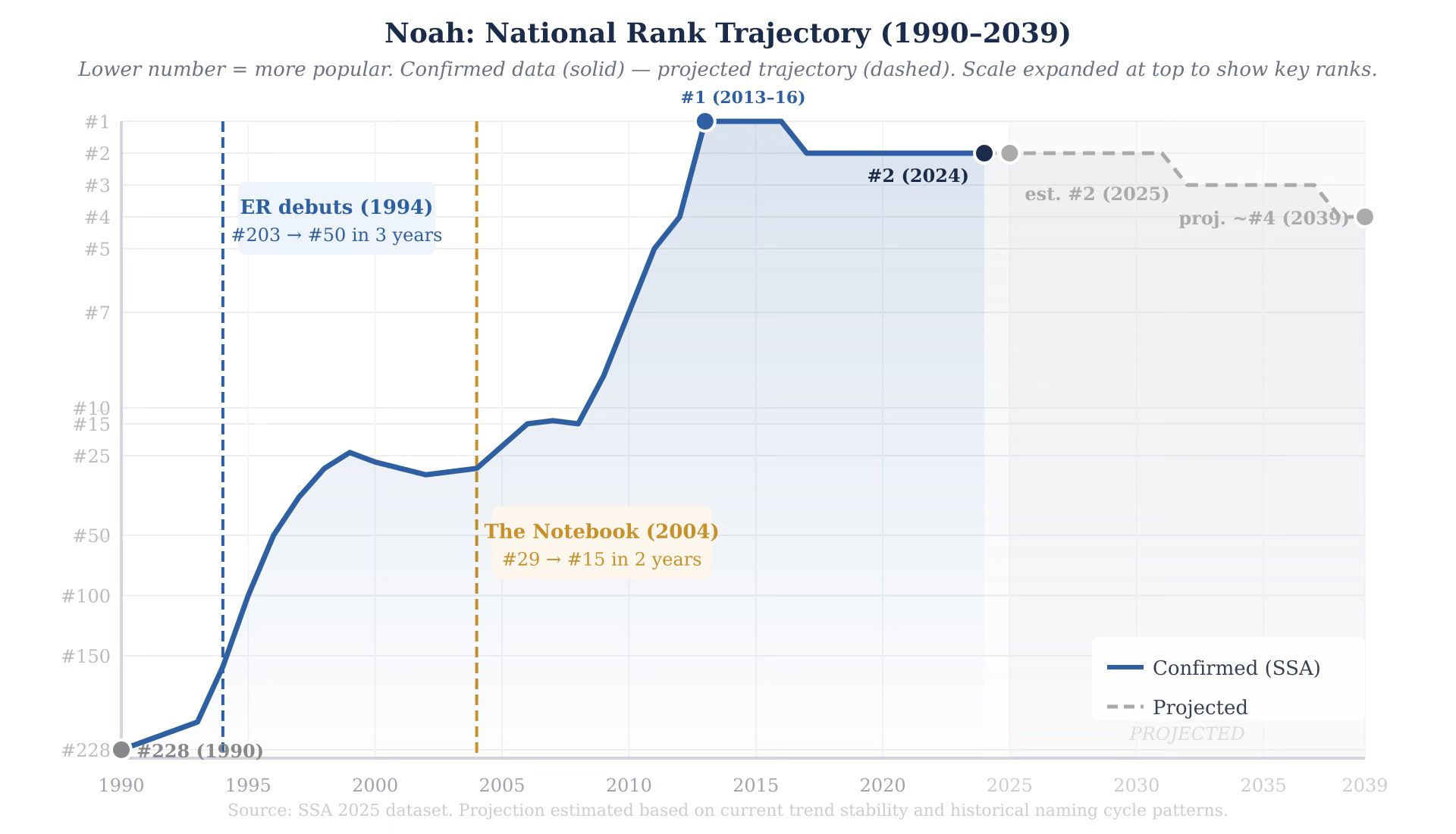
In 1990, a name sat at rank #228 with 1,296 births across the entire United States. It wasn’t obscure, but it wasn’t a powerhouse; it was a name people recognized from the Bible but had largely moved on from.
Then something shifted.
In 1995 it had cracked the top 100.
By 1996 the top 50.
Three years later it broke the top 25.
Ten years after that in 2009, the top 10.
And finally in 2013, it was #1, dethroning Jacob after 13 consecutive years at the top.
The name?
Noah.
All of this during the period of maximum naming fragmentation in American history. While the consensus mechanism was collapsing around every other name, Noah continued to climb.
And not at a slow pace.
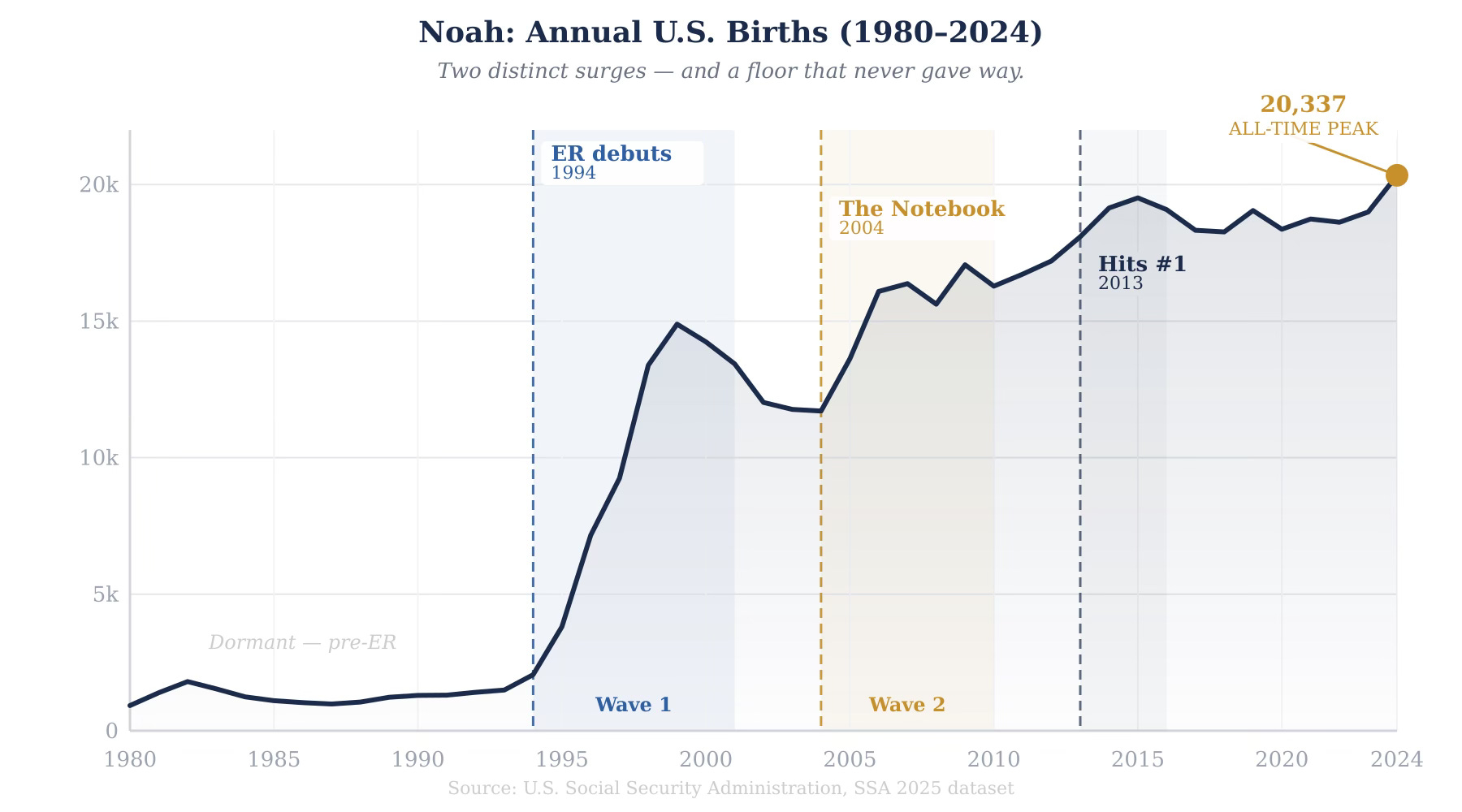
Since losing the top spot in 2017, Noah has held #2 every single year without exception. In 2024, 20,337 boys were named Noah. That is not near the all-time peak. That is the all-time peak, set seven years after relinquishing #1. The same year, it dethroned Liam as New York City’s #1 boys’ name, a title Liam had held since 2016.
The estimated 503,000 living Americans named Noah are almost entirely under 30. Still entering school. Still entering workforces. Still building the social fabric of this country. And if you were hoping the name’s cultural saturation had peaked, on the contrary: it’s only just begun.
By 2030, Noah will be the most common name in entry-level offices, college rosters, and Slack channels. Every HR department in America will have one. Every Little League team. Every warehouse. Every Teams call.
It’s already happening in public life. In everything, everywhere, all at once.
Start with the original.
Noah Wyle is 54. He was the man who lit the fuse in 1994 as Dr. John Carter on “ER”, the character that sent the name rocketing from #203 to #50 in three years. Thirty years later, he’s still the most relevant Noah in Hollywood. “The Pitt” won Outstanding Drama Series at the 2025 Emmys. Wyle beat Pedro Pascal, Adam Scott, and Gary Oldman for Lead Actor, his first Emmy win. His acceptance speech closed with: “For anyone going on shift tonight, this is for you.”
Then the flood hits.
Noah Schnapp anchored the last decade’s cultural phenomenon of “Stranger Things,” while Noah Centineo became the face of Netflix’s rom-com era. On the digital front, Noah Beck turned a TikTok following into a legitimate entertainment career, recently landing a role in the “Baywatch” reboot.
Noah Eagle has become the fastest-rising voice in American broadcasting before most of his peers have cleared local television. He called play-by-play for the Super Bowl and the Olympics. Sports Emmy winner. His father, Ian Eagle, is one of the most respected voices in the business.
In the sports world there’s Noah Lyles. Olympic 100-meter gold medalist at Paris 2024. Eight-time world champion. The fastest man on earth. Born in 1997. In a sport built entirely on speed, he even beat Speed.
And then there’s Noah Kahan. One of the defining musical voices of his generation. Born in 1997 in rural Vermont, “Stick Season” became a global phenomenon, hitting #1 across streaming platforms in 2024. Grammy nominated. Headlining festivals. A Netflix documentary in the works. He is not emerging. He has arrived.
From the man who started it all to the generation he helped create, Noahs are at the top of film, television, music, broadcasting and track simultaneously. That’s not coincidence. That is a generation coming of age.
So what drove it?
Three things, arriving perfectly in sequence, over thirty years.
First: Television.
“ER” debuted on September 19, 1994, and within weeks became the second most-watched show in America after “Seinfeld”. One of its leads was Noah Wyle, playing the beloved Dr. John Carter. While audiences fell in love with Wyle on screen, his name slowly grew to mean more to would-be future parents. And nobody consciously registered it. In 1993, Noah ranked #203. By 1996 it was at #50. A 150-rank jump in three years. All thanks to one man on one show.
Second: Culture.
Noah didn’t rise alone. It rode a broader Old Testament wave. Joshua had been a top-5 staple since 1983. Jacob hit #1 in 1999 and held it for 13 years. Elijah and Isaiah climbed steadily through the 2000s. Evangelical Christianity’s expansion through the ‘80s and ‘90s created a decade-long runway for names that felt grounded and ancient. Noah was positioned perfectly on that runway, with one advantage the others didn’t have: everybody already knew his story. Noah’s Ark is the most universally recognized biblical narrative in the world. Belonging to Christians, Jews and Muslims alike. No other name in the top 10 carries that range. Noah has ranked near the top of naming charts across Europe and North America for more than a decade, and has remained in the US top 10 for 17 consecutive years.
Third: Ryan Gosling.
“The Notebook” came out in June 2004. Noah ranked #29. Two years later, #15. Four thousand additional births. The effect is right there in the data. Ryan Gosling’s Noah Calhoun was working class, loyal, and quietly strong. He built a house with his hands and wrote love letters every day for a year. That character became the measuring stick for an entire generation of soon-to-be parents for what a good man looked like.
Underneath all three: the name itself. Two syllables. Meaning “rest”, “repose” or “comfort”. Nickname-proof. It works the same in English, Spanish, French, Arabic, and Hebrew. And it doesn’t date itself the way almost every other name does. Michael sounds mid-century. Brandon sounds like the ‘80s. Tyler the ‘90s. Noah sounds like it could belong to anyone, born in any year, carrying any ambition.
That’s why it’s still here.
The names we give our children are never just names.
They’re a signal. A hope. A quiet vote for the kind of person we want them to become.
Michael was a name for an era of certainty, when culture moved in mass and one name could speak for millions. Jennifer did the same for girls - peaking at 3.4% - dominating a decade, then disappearing from the top five entirely. One era, one name, then gone.
Noah achieved generational significance in an era where the top name owns barely 1%.
These are not the same.
Noah didn’t have the tailwind of monoculture. It won in spite of fragmentation. It climbed through a landscape actively fighting against any single name becoming dominant, reached the top anyway, and has kept climbing.
Noah is a name for the era we’re actually in.
An era of fracture and a thousand parallel choices. It achieved something that should have been statistically impossible: a generational consensus, in a generation that doesn’t agree.
That’s not the new Michael.
That’s grit.
20,337 boys named Noah in 2024. The name’s current all-time high, set seven years after losing #1. Zero signs of slowing down.
There’s a generation of kids growing up right now who will see their name in sports, music, TV and film amongst hearing it shouted at their local bar, office, or school. A name that once felt rare has become the staple of an entire era.
If you don’t No-ah Guy yet...
You will.