

Think about the last time you met someone named Michael.
Probably didn’t take long. There are an estimated 4.1 million of them alive in America right now. More people than the city of Los Angeles.
Michael was the most popular boys’ name in America for 44 of the last 100 years. At its peak, more than 5% of all male births carried it. One name. One in twenty boys. You couldn’t walk into a classroom, a bar, or an office without finding one.
Jennifer did the same for girls. Then Jessica. Then Emily, 13 years at the top. In every era, one name absorbed a disproportionate share of the country’s imagination and held it.
That world is gone.
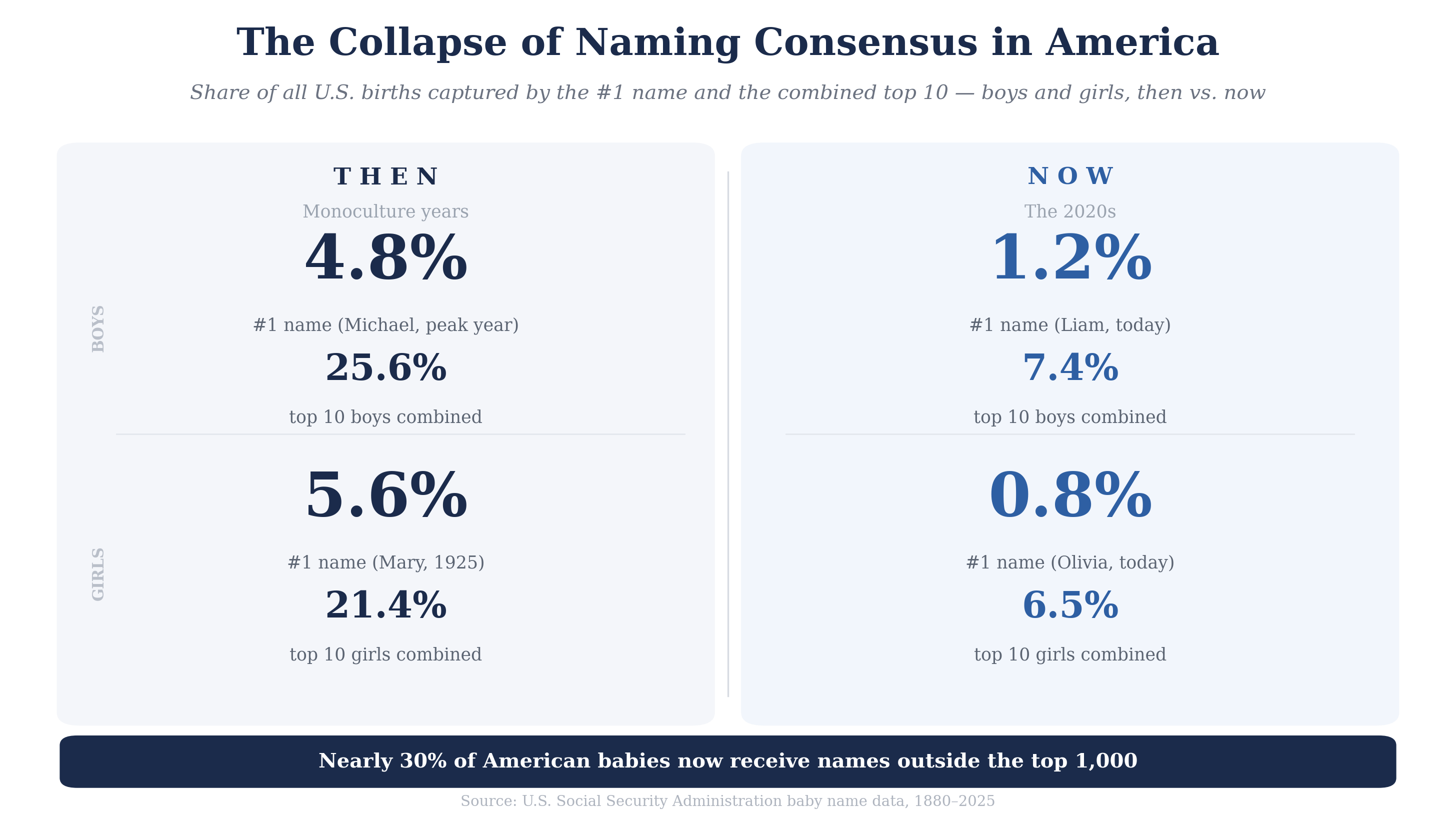
In 1925, Mary accounted for 5.6% of all girls born in America. Jennifer peaked at 3.4% in the 1970s. Today Olivia sits at #1 with 0.8%.
Michael once commanded 4.8% of male births. Liam, the current #1, takes about 1.2%.
The top 10 boys’ names once covered 25.6% of all male births.
The top 10 girls’ names covered 21.4%.
Today: 7.4% and 6.5%.
Nearly 30% of American babies now receive names outside the top 1,000.
The playground test is broken. Shout a name across a schoolyard and watch nothing happen. The internet fragmented culture, and naming went with it. A few dominant names became thousands of small ones.
We have never, in recorded American history, been less uniform in what we name our children.
Names used to move through America the way everything did: slowly and together. A handful of TV shows. A shared radio dial. A few national magazines. When a name caught on, it caught on everywhere.
The internet shattered that. Culture now splinters into thousands of overlapping communities, each with its own celebrities, aesthetics, and influences. Naming followed. The statistical center collapsed.
Which makes what happened next the most interesting story in modern American naming data.
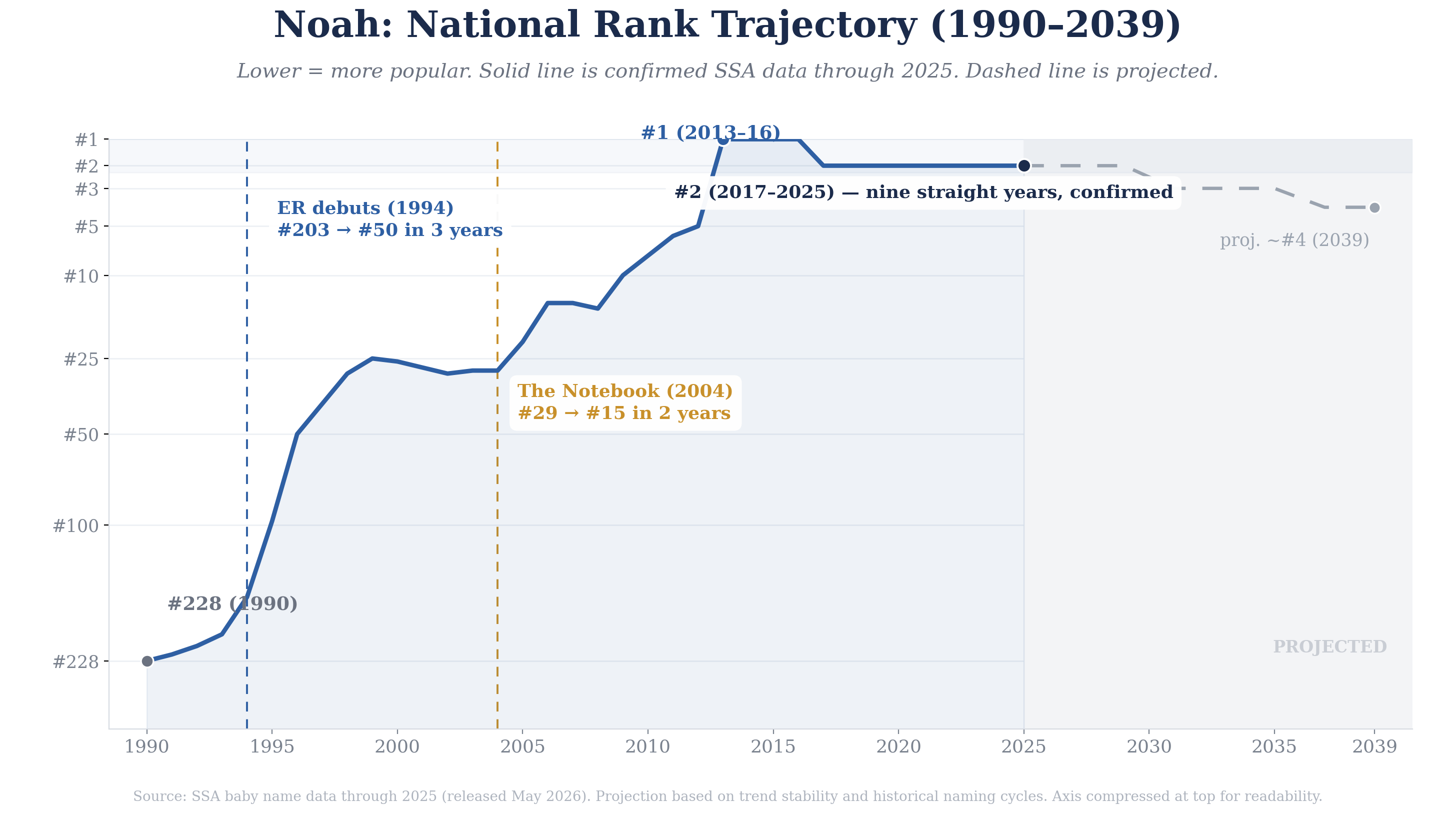
In 1990, a name sat at rank #228 with 1,296 births across the entire United States. Recognizable from the Bible. Largely abandoned.
Then something shifted.
By 1995 it had cracked the top 100.
1996, the top 50.
Three years later, the top 25.
2009, the top 10.
And in 2013 it hit #1, dethroning Jacob after 13 straight years on the throne.
The name?
Noah.
I should know. I’m one of them.
All of it during the period of maximum naming fragmentation in American history. While the consensus machine was breaking down around every other name, Noah kept climbing.
It hasn’t stopped.
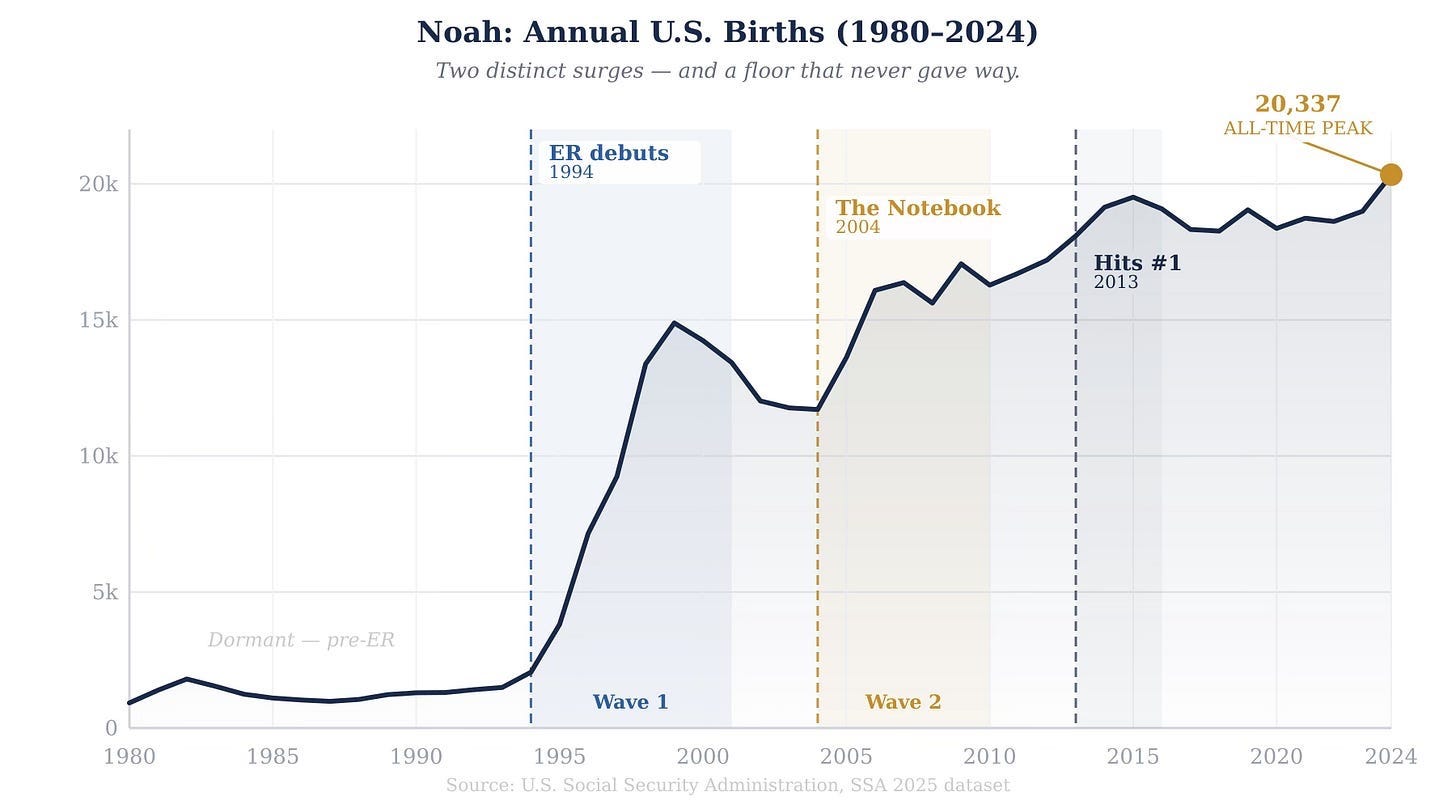
Since losing the top spot in 2017, Noah has held #2 every single year. Nine straight and counting. In 2024, 20,337 boys were named Noah. Not near the all-time peak. The all-time peak, set seven years after giving up #1.
Read that again. Names decline after they peak. Michael did. Jacob did. Jennifer vanished from the top five entirely. Noah lost the crown and set its own birth record seven years later.
And 2025 is where the fun begins.
While the Social Security Administration says Noah was #2 in America, almost everyone else counting says #1.
New York City returned Noah to the top, reclaiming his throne as the No. 1 boys’ name in America’s largest city and ending Liam’s eight-year reign.
Louisiana crowned Noah #1 for 2025. So did New Mexico. So did Puerto Rico.
BabyCenter already has Noah at #1 nationally, ahead of Liam.
Cross a border and it keeps going:
British Columbia: #1.
Scotland: #1.
Northern Ireland: #1.
New South Wales, Australia: #1.
America (currently) says second place. The world says first.
Meanwhile, the estimated 503,000 living Americans named Noah are almost entirely under 30. Still entering school. Still entering workforces. Still building the social fabric of this country.
If you were hoping the saturation had peaked: it’s only just begun.
By 2030, Noah will be the most common name in entry-level offices, college rosters, and Slack channels. Every HR department in America will have one. Every Little League team. Every warehouse. Every Teams call.
The flood has already hit public life.
Noah Schnapp anchored “Stranger Things.” Noah Centineo became Netflix’s rom-com face. Noah Beck turned a TikTok following into a series-regular role on Fox’s “Baywatch” reboot.
Noah Eagle is the fastest-rising voice in American broadcasting, following his father Ian, one of the most respected in the business: Super Bowl on Nickelodeon, Team USA basketball in Paris, NBC’s primetime college football package. Sports Emmy winner. All before 30.
Noah Lyles is the fastest man on earth. Olympic 100-meter gold at Paris 2024. Eight world titles. Born in 1997. In a sport built entirely on speed, he even beat Speed.
And Noah Kahan, also born in 1997, turned “Stick Season” into a multi-platinum global phenomenon. Two Grammy nominations. Sold out stadiums nationwide. A Netflix documentary.
Noahs sit at the top of film, television, music, broadcasting, and track at the same time. A generation is coming of age, and it answers to one name.
So what drove it?
Three things, in sequence, over thirty years.
First: television & the Noah that started it all.
“ER” debuted September 19, 1994, and became the second most-watched show in America behind “Seinfeld.” Audiences fell for Noah Wyle’s Dr. Carter, and the name quietly took root with future parents. Thirty-one years later, the OG Noah won his first Emmy for 'The Pitt.' In 1993, Noah ranked #203. By 1996, #50. A 150-rank jump in three years, off one man on one show.
Second: culture.
Noah rode a broader Old Testament wave. Joshua was a top-5 staple from 1983. Jacob hit #1 in 1999 and held it 13 years. Elijah and Isaiah climbed through the 2000s. Evangelical Christianity’s expansion in the ‘80s and ‘90s built a runway for names that felt grounded and ancient, and Noah stood on it with an advantage the others lacked: everyone already knew his story. Noah’s Ark belongs to Christians, Jews, and Muslims alike. No other name in the top 10 carries that range.
Third: Ryan Gosling.
“The Notebook” came out in June 2004, when Noah ranked #29. Two years later: #15. Four thousand additional births. Gosling’s Noah Calhoun was working class, loyal, and quietly strong. He built a house with his hands and wrote 365 letters. He became the measuring stick for what a generation of soon-to-be parents thought a good man looked like.
Underneath all three: the name itself.
Two syllables. Nickname-proof. Works the same in English, Spanish, French, Arabic, and Hebrew. And it refuses to date itself. Michael sounds mid-century. Brandon like the ‘80s. Tyler, the ‘90s. Noah could belong to anyone, born any year, carrying any ambition.
That’s why it’s still here.
A name is a signal. A hope. A quiet vote for the kind of person we want a child to become.
Michael won in an era of certainty, when culture moved as one and a single name could speak for millions. Jennifer peaked at 3.4%, owned a decade, then vanished from the top five. One era, one name, then gone.
Noah has persevered despite the collapse of monoculture. It climbed through a timeline actively working against any single name becoming dominant and landed in the top two for 13-years straight.
The name means rest. Comfort.
It’s earned a third meaning:
Grit.
Nine years at #2 in the official standings. First place in New York, Louisiana, New Mexico, Puerto Rico, Scotland, and probably your local maternity ward.
Half a million of us, almost all under 30, just getting started.
Consider this your warning.
If you don’t No-ah Guy yet...
You will.